


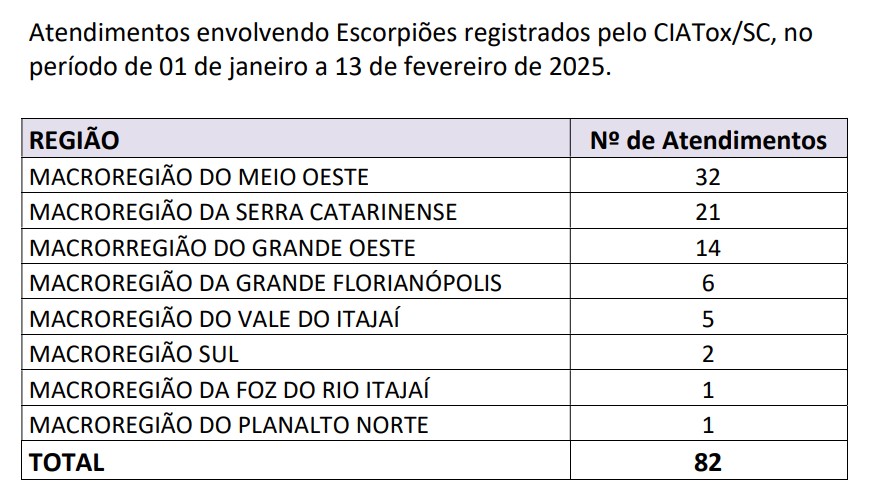
Heat and high humidity contribute to the increase of incidents with venomous animals, especially scorpions, that become more active at this time. Data from the Santa Catarina Toxicological Information and Assistance Center (CIATox/SC), of the State Department of Health (SES), show that, only between January 1st and 13 February, were attended 82 cases of accidents involving scorpions in the state.
The biologa TACIANA SEEMANN, do CIATox/SC, explains that the increase in the number of cases is expected during the warmer and rainy months. “In this period, Scorpions are more active and have a greater supply of food, which increases the likelihood of meetings with humans ”, affirms. A specialist emphasizes that, Although most accidents are not serious, You need to be aware of the most medical species.
“In our state, The most medical scorpions are brown scorpion species (Tityus bahiensis), with seven cases registered in 2025, and the yellow scorpion (Tityus serrulatus), with five cases so far ”, reports Taciana. She points out that the yellow scorpion, Although not native to the southern region, has been proliferated due to its ability to adapt to urban environments, as sewage galleries and similar places where you find shelter, water and food as cockroaches, besides being able to reproduce asexual, Without the need for the male. Among the scorpion species found in Santa Catarina, The yellow scorpion is the most dangerous.
“Native species are part of our local fauna and act in the balance of the ecosystem. Greater attention should be given to invasive species, like the yellow scorpion, considering its high ability to adapt to the urban environment and cause more serious cases, characteristic not observed in local species ”, explains Taciana Seemann. The cases involving the yellow scorpion were recorded in Blumenau (1), Northern arm (1), São José (1), Tijucas (1) and Ituporanga (1).
Of the 82 CREATOX REGISTERED COMPLAINTS, 25 involved the species Tityus costatus, popularly known as brown or stained scorpion. This species has great distribution, mainly in the regions of the Midwest, West and Serra Catarinense. Although it does not cause serious accidents and is considered of minor medical importance, in southern Brazil, o “Tityus costatus”Presents a darker color, Being very similar to the brown scorpion (Tityus bahiensis), also known as brown scorpion, This is considered dangerous.
The other cases were identified only by the genus Tityus (21) or it was not possible to determine the scorpion species involved (24). During that period, No serious cases were recorded, e, over the 40 years of operation of Ciatox/SC, There were no deaths related to scorpion accidents.
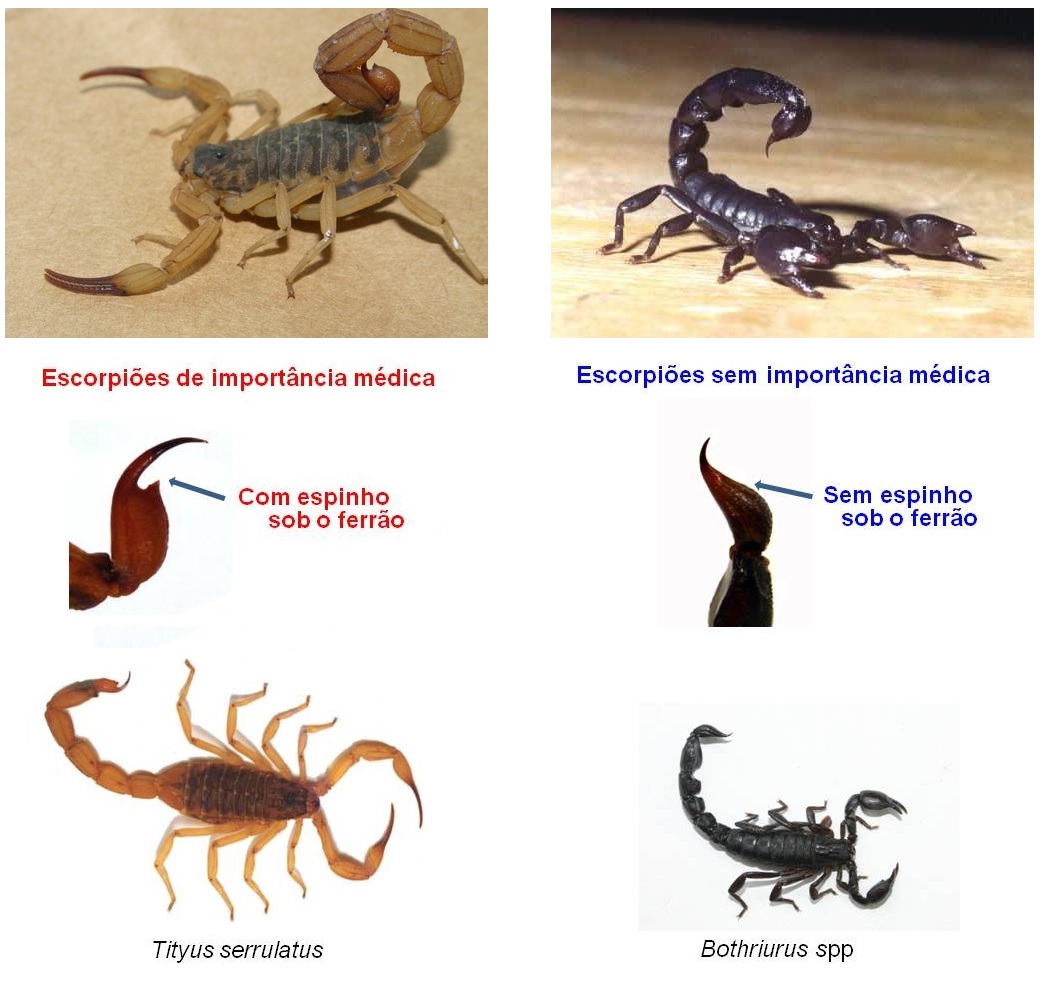
How to differentiate dangerous scorpions from non -dangerous?
The scorpions of medical importance that occur in Brazil are of the genus Tityus SP. and have a thorn just below the sting. Furthermore, Its color is more matte, different from scorpions without medical importance, that appear to be naturally varnished, because its color is more “bright”.
Santa Catarina also houses species of scorpions that do not pose a risk to health. The so-called black scorpions, of the genus Bothriurus SP, are harmless to humans and can be recognized for their dark and brilliant. “Different from venomous species, They have the poison and can chop, however it has no harmful effect to the human being, causing only local and light pain ”, clarifies the biologist.
Prevention and Care
The biologist warns that the use of insecticides, popularly called poison, It is not effective in combating scorpions. “Some research shows that the use of poisons can even cause the increase in the population, since their use only causes their temporary disallowance, favoring the dispersion of outbreaks, besides having a chitin coating, that leaves them impermeable to the poison. Control is more effective by eliminating possible life environments or possible insects that serve for your diet ”, Explain.
To avoid proliferation, Accident prevention should consider the habits and habitat of the scorpion.
Some preventive measures include
- Keep home always clean;
- Remove debris, construction remains and unusable materials that favor the shelter of scorpions or their food;
- Doors;
- Cover or teal ground drains, sinks and tanks;
- Check footwear and clothes before wearing;
- Keep the beds away from the wall;
- Maintain cleaning of vacant lots near the residence;
- Towing walls and walls so that they do not have spans and cracks;
- Wear closed shoes and gloves in gardening activities, external cleaning, Construction and Agriculture.
In the event of an accident, Taciana guides: “Wash the bite site with soap and water and refer the victim to the nearest medical service. Preferably, take a picture of the animal that caused the accident, to identify its characteristics ”. She also points out that the most serious cases usually happen with children and the elderly, and that the specific treatment for scorpion bites is anti -scorpion serum or anti -equity serum. "Although, It is only used for moderate and severe cases ”, complete.
Yellow scorpion
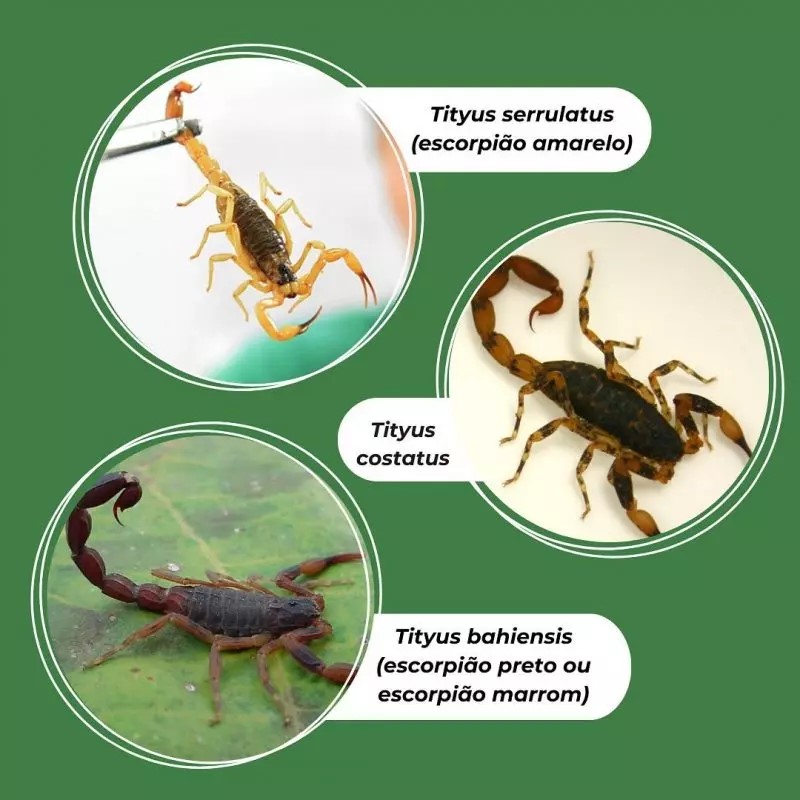
A point of concern is the growing presence of the yellow scorpion, native species of other regions, but that has easily adapted to the urban environment in the south of the country. “This species, particularly, can reproduce asexual, Without the need for the male, which facilitates its proliferation when it finds a favorable environment in the urban environment ”, explains Taciana. Among the scorpion species found in Santa Catarina, The yellow scorpion is the most important medical. That's why, infestation cases should be communicated immediately to the Epidemiological Surveillance of the Municipality.
Coming from the Southeast Region, The yellow scorpion is very resistant and can be transported by highways in fruit transportation, machinery, furniture and wood, for example. It is a very adapted species to cities where it feeds mainly on cockroaches, may be lodged on vacant lots, sewage galleries and similar places where she finds shelter, water and food.
O CIATox/SC, free service in partnership with UFSC, is available 24 hours a day for guidance in cases of accidents with venomous animals. The contact can be made by the number 0800-643-5252 or through the website ciatox.saude.sc.gov.br.
With information from the government of Santa Catarina