
Healthy eating for cattle, the correct destination of waste harmful to nature and the possibility of financial gains for supplier and consumer. Apple bagasse is an alternative for cutting livestock, And viability is studied at Epagri.
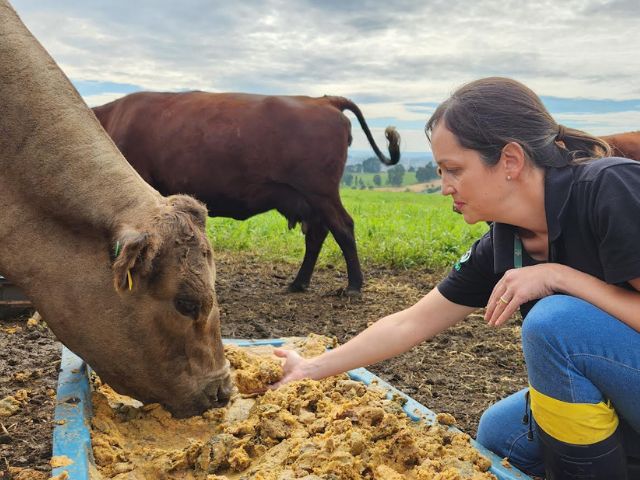
A pesquisa é conduzida pelas zootecnistas Vanessa Ruiz Fávaro e Ângela Fonseca Rech, both from the experimental station in Lages. Aware of good results obtained by other professionals with orange, uva, pineapple and even beer residues, Vanessa and Angela inserted the apple into the list of experiments, Taking advantage of the huge supply of fruit in the Santa Catarina mountain, Especially in the São Joaquim region, that should harvest approximately 290 thousand tons in this crop.
With field and laboratory activities, Researchers seek to evaluate apple bagasse, produced by industry after fruit processing, as a food alternative for cattle, replacement or complement to other noble and human consumption foods, like corn and soy. The goal is not to put the residue of the fruit as the only food of the animal, but introduce it as a component of an appropriate diet.
“Apple bagasse is poor in protein, but rich in energy. Also has soluble carbohydrate and easy digestion, which releases nutrients faster when the animal eats. That's why, It is important to balance food ”, Explain the researchers.
The focus of studies is not the cattle in confinement, but in grazing, where there is oscillation in pasture growth throughout the year. In the falling fall, Pasture lack happens. Like this, Apple bagasse enters as strategic supplementation, because it requires planning.
The producer can conserve the residue in the form of silage, No minimal 40 dias, before making it available to the animal. I.e, just now, At this time of year, When the apple harvest is in the early stages, you can store the bagasse to use it in the fall. The harvest period is ideal for this. Storage in the form of silage preserves the residue, avoiding outdoor exposure, undesirable fermentations and the production of toxins that can even result in the death of animals.
Research at Epagri Lages already points out that apple bagasse remains in good condition until one year later, provided that it is properly kept in silo without oxygen to prevent unwanted fermentation. And the expectation is that the studies will evolve to indicate that this period can be up to two years with the closed silo.
“Many producers already have silo on their properties and can make adaptations at no cost”, guide zootechnists.
Producer needs to know the residue before feeding cattle
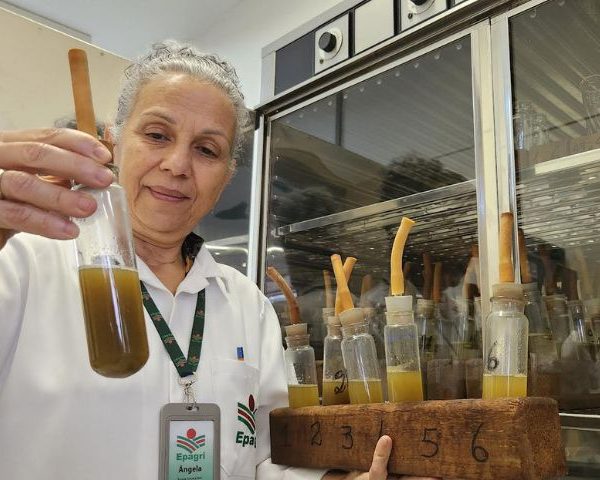
Although it is a good food alternative for cattle, Researchers Vanessa Fávaro and Ângela Rech guide producers to know the apple bagasse who will use. They warn that agro -industrial waste has no quality standard, and the composition may vary depending on the processing by the industry, which requires a bromatological analysis of the material.
The material experienced by Vanessa in the field is analyzed by Ângela in the animal nutrition laboratory, where protein contents are evaluated, dry matter, organic matter, fiber, fat and digestibility estimation.
Producers can have access to this type of analysis in private laboratories or even in the Lages Experimental Station itself, The only Epagri who performs this service in Santa Catarina.
Good environmental and economic alternative for the industry
Although it is necessary to evaluate the viability of transportation, whereas the apple bagasse is a very damp material, composed of about 80% water, Your use for animal feed can be a good opportunity for the industry, which has an obligation to give the correct final destination because it is a polluting material when discarded incorrectly.
This way, The industry can market the waste to the producer, fulfilling a requirement of environmental legislation and earning something that would be discarded. Already the producer, in turn, can acquire quality food at a lower cost than others more noble.
Studies advance and will guide the producer
Epagri Lages Zootechnicians studies are financially supported by the Santa Catarina State Research and Innovation Foundation (Fapesc) and supply of apple bagasse to the company TC Agronegócios.
The goal of Vanessa and Angela is to publish, em 2026, a didactic newsletter with technical information about the step -by -step use of apple bagasse, so that the producer knows how to proceed in relation to silage and to which categories of animal to offer the residue of the fruit that bears the name of the Santa Catarina saw to the most demanding consumer markets in the world.
- With information from Epagri